

White Dwarfs

Van Maanen 2, the closest isolated white dwarf
White dwarfs are the most common stellar remnant, the remaining degenerate core of hydrogen-burning stars with a mass below eight solar masses. The study of white dwarfs provides insights about the physics at extreme densities and information about the star formation history of the Milky Way. The Gaia satellite has permitted the production of the largest white dwarf catalogues up to date thanks to its parallax information. We complement the Gaia data with the twelve-band photometry from J-PLUS, improving the estimation of the effective temperature and providing a better discrimination between the most typical H-dominated atmosphere white dwarfs, presenting hydrogen lines (DA type), and other He-domintaed types such as DB (helium lines), DC (featureless continuum), DZ (metal lines), etc.
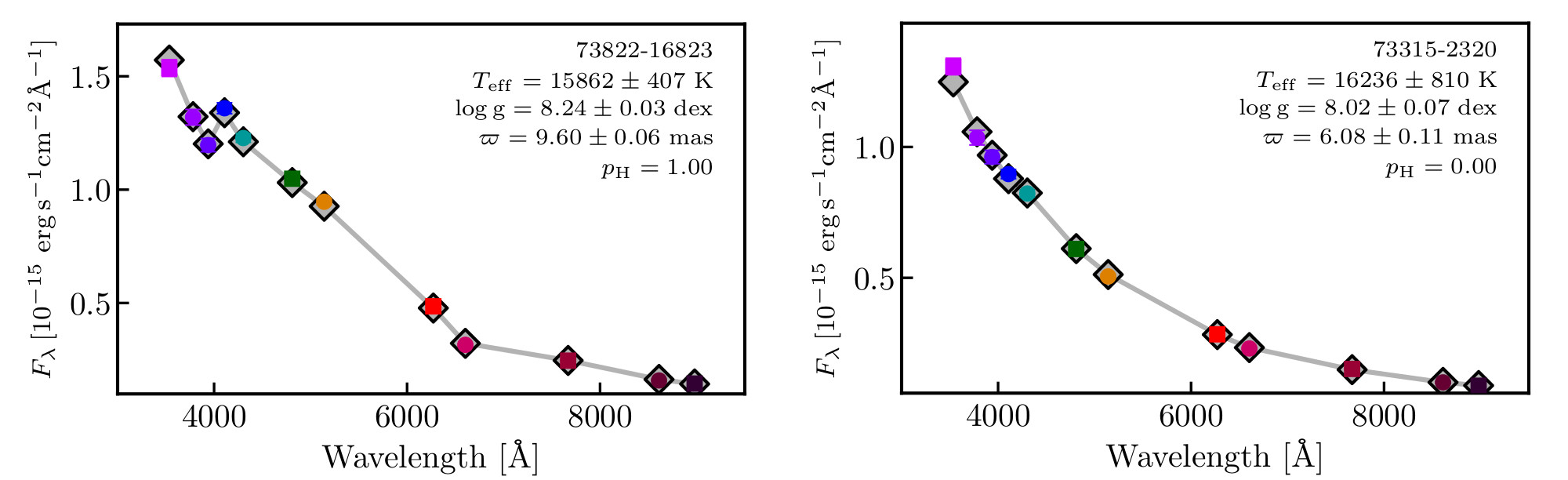
Figure 1. J-PLUS photometry of a DA (left) and a DB (right) white dwarf. The grey diamonds connected with a solid line show the best-fitting white dwarf model, with the derived parameters and their uncertainties labelled in the panels: effective temperature (Teff), surface gravity (log g), parallax (ϖ), and H-dominated probability (pH). Figures from López-Sanjuan et al. 2022.
ATMOSPHERIC PARAMETERS AND COMPOSITION FROM J-PLUS PHOTOMETRY
We used J-PLUS DR2 in combination with the Gaia EDR3 white dwarf catalogue from Gentile Fusillo 2021 to analyse the atmospheric parameters (effective temperature, surface gravity, parallax, and spectral type) of 5926 white dwarfs with r < 19.5. The results are presented in
López-Sanjuan et al. 2022 : Spectral evolution of white dwarfs by PDF analysis
We estimated the fraction of He-dominated white dwarfs with effective temperature (Fig. 2). We find an increase in the He-dominated fraction with cooling time, growing for a minimum of 8% at Teff > 20000 K to 30% at T = 5000 K.
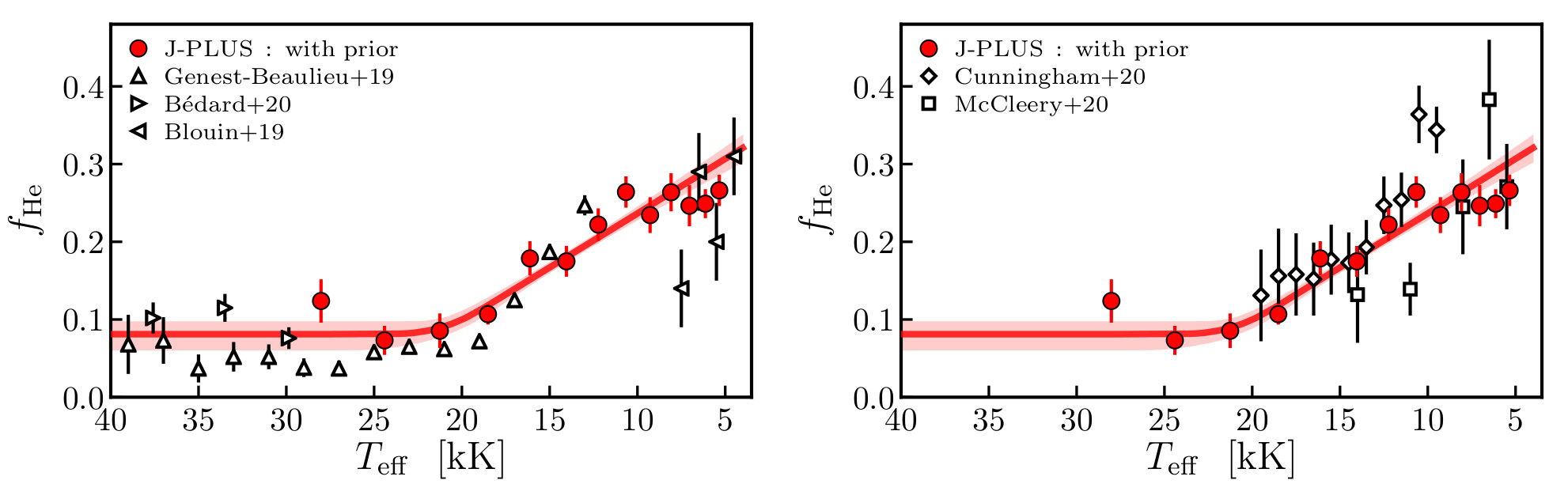
Figure 2. Spectral evolution of white dwarfs from J-PLUS photometry (red symbols). Previous results in the literature are labelled in the panels. Figures from López-Sanjuan et al. 2022.
We also analysed the mass distribution of the 351 white dwarfs at d < 100 pc, Teff > 6000 K and mass M > 0.45 M☉. The result for H-dominated white dwarfs agrees with previous work, with a dominant M∼0.6 M☉ peak and the presence of an excess at M∼0.8 M☉. This high-mass excess is absent in the He-dominated distribution, which presents a single peak.

Figure 3. Mass distribution of H- and He-dominated white dwarfs from J-PLUS photometry at d < 100 pc. Figures from López-Sanjuan et al. 2022.